We use cookies to give you the best experience on our website. You can choose which cookies you want to allow below. You can find more details in our not the small print.
Essential cookies are cookies that are needed for the proper functioning of the website.
Analytics cookies are used so we can track how visitors use our website and improve it based on that information.
GAP: How have online providers responded to the FCA intervention?
GAP insurance was recently suspended by the FCA due to their concern about the value it was providing for customers. The suspension has now ended and many providers are back to selling policies, but how have the policies changed since the FCA's intervention?
By Peter Roper
Earlier this year, GAP insurance gained significant attention when the FCA temporarily suspended sales. This move was driven by concerns over the value of GAP insurance policies and the high commissions some providers were paying to car dealerships (with certain firms paying out as much as 70% of insurance premiums in commissions). The FCA’s 2022 General Insurance value measures data revealed that GAP insurance policies, whether sold as add-ons or standalone products, paid out a smaller proportion of premiums in claims than any other insurance sector. While add-on GAP policies remained at the bottom of this measure in the recently released 2023 data, standalone GAP policies have slightly improved, moving ahead of motor excess and personal accident add-on policies.
Add-on GAP policies faced harsher criticism from the FCA due to their high commissions and low percentage of premiums paid out in claims. However, despite some improvements reflected in the 2023 value measures data, standalone GAP policies were also suspended by the FCA because they also had very low percentages of premiums paid out in claims. With the suspension lifted, some providers have reintroduced these policies to the market. Fairer Finance is unable to collect data on add-on GAP policies, but we cover all online standalone providers and have been monitoring the changes in this segment of the market before and after the FCA’s intervention.
Product Changes
The shift in value measures data from 2022 to 2023 indicated progress among standalone GAP providers, with the percentage of premiums paid out in claims rising from 7% to 22%. However, this data was collected prior to the FCA’s intervention. Since then, online GAP providers have made significant changes to their policies in an effort to demonstrate to the FCA that they are now offering fair value
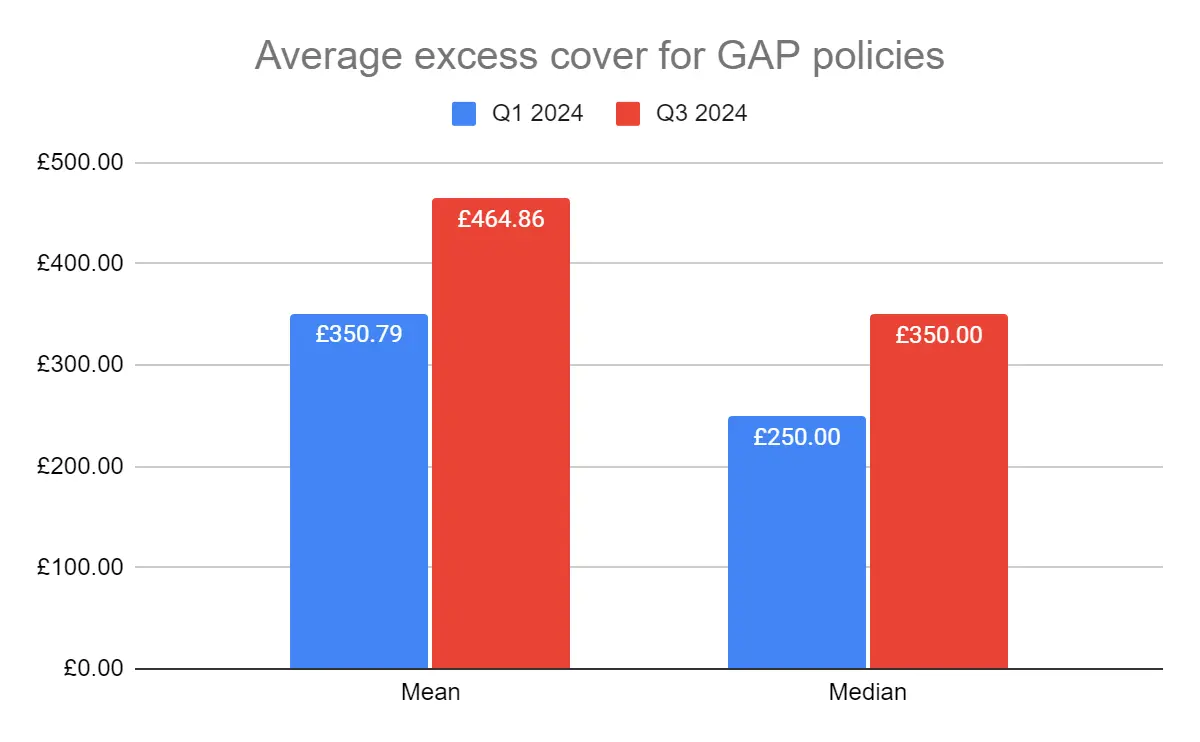
One notable change, as observed in Fairer Finance’s product data, is the significant increase in the amount of excess cover provided by standalone GAP policies. Excess cover is a standard feature of nearly all GAP insurance policies, designed to cover part (or all) of the car insurance excess during a total loss claim. Between the start of 2024 and now, the mean amount of excess cover offered by standalone GAP policies increased by over 30%, and the median amount rose by 40% (see below)
Another area of improvement is in the coverage of paintwork protection systems as part of a GAP claim. Before the FCA intervention, only 6% of policies offered any cover for this, but among the policies now available, this has increased to 37%. Similarly, the number of policies offering no cover for dealer-fitted car accessories has almost halved.
Car2Cover launched a new ‘advanced’ policy, incorporating features that were already offered by a small number of providers, such as car hire cover in case of an accident. They also introduced completely new features, like excess cover for non-total loss claims, making it the only policy to offer this. Car2Cover has approached the FCA intervention by creating a combined motor excess/GAP policy to enhance value. This approach could become more widespread, given that all motor add-on sectors currently have very low percentages of premiums paid out in claims.
Information Display
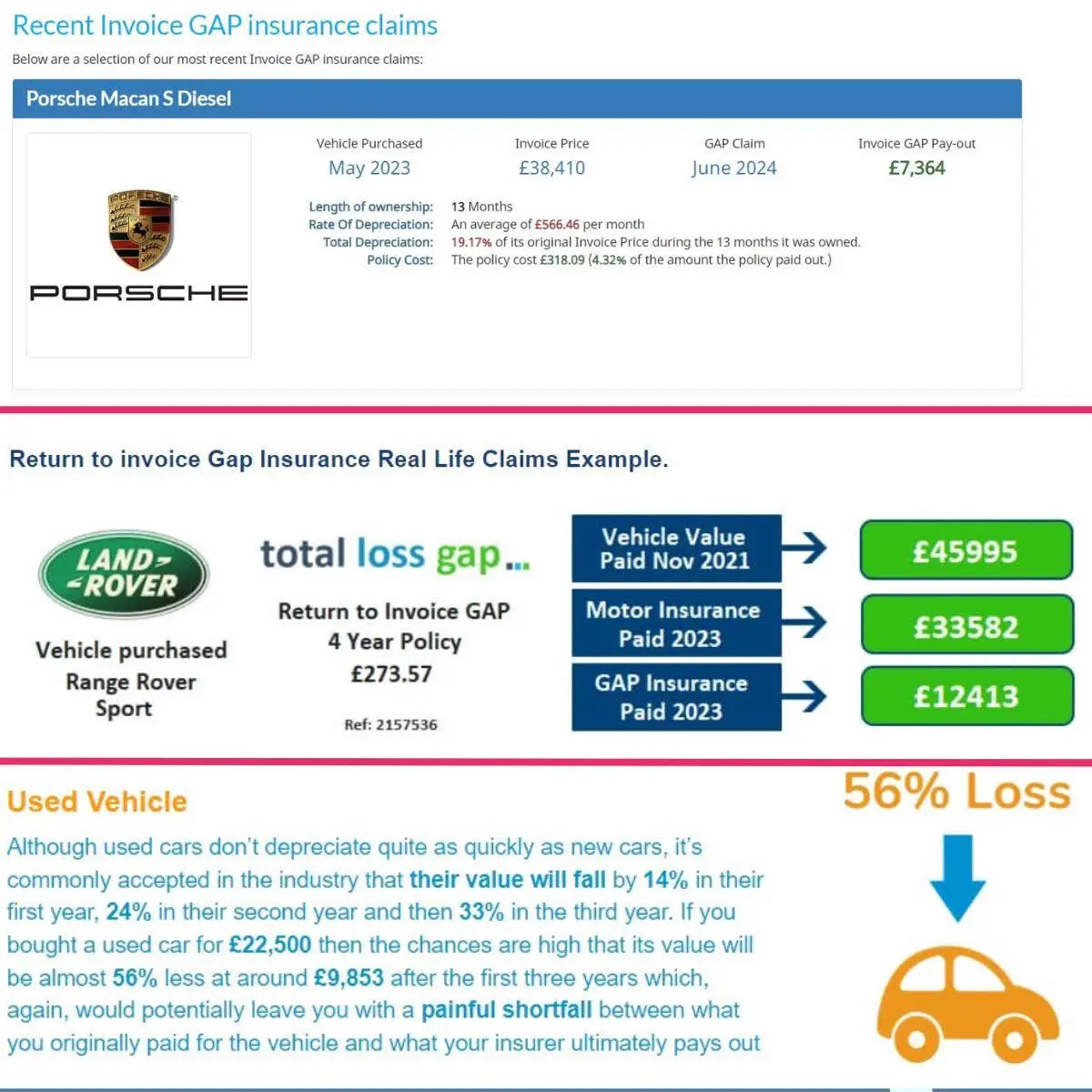
Providers like GAPInsurance.co.uk and TidyAlloys.com feature real quote examples and information about depreciation (see below). This is valuable to customers and a helpful addition to their websites. Providing worked examples is a good practice, as it helps customers understand complex concepts like depreciation.
While most brands don’t include this information, even those that do could further improve by integrating this information into the quote journey itself. Currently, some of this information is displayed near the bottom of long web pages, where buyers are likely to miss it.
Customers need this information at the point of decision-making. Using interactive charts and graphs within the quote process would be an effective way to show customers the potential benefits of policies in a format that is both visible and easy to understand.
One key piece of information missing from these providers’ online journeys is the percentage of people who make a claim and the overall percentage of premiums paid out in claims. These statistics were crucial in attracting the FCA’s attention and are important indicators of a policy’s value, alongside the average claim payout.
Complacency
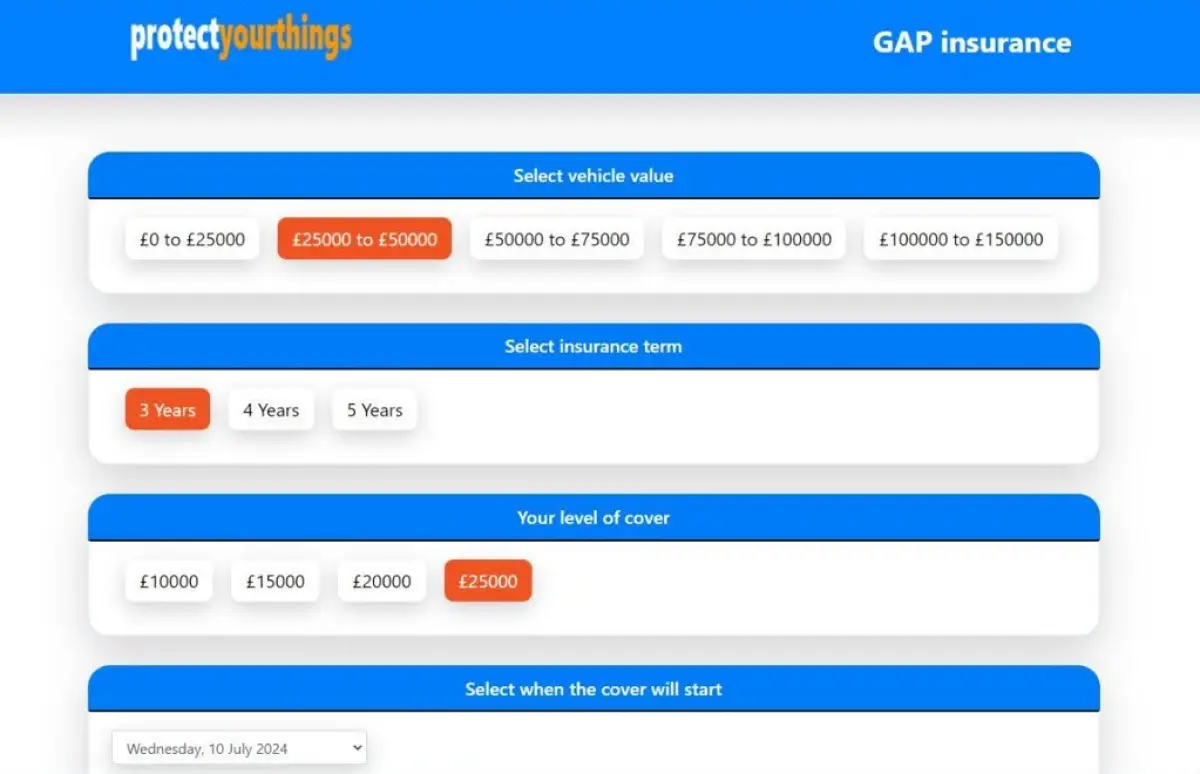
Not all providers are making these helpful changes and more work needs to be done. Some providers have started selling policies again with no visible changes. The image below comes from Protectyourthings, Usually online GAP insurance providers generate a quote from the purchase price of the car, without offering a choice of cover levels.
In some circumstances more options can help customers to better tailor policies to their needs. However, the lack of any additional information on this page means customers are potentially making uninformed and poor decisions.
This design choice could tempt customers to select a level of cover equal to the value of their car, to ensure that they’re fully covered. However, this would be an excessive amount of cover. Even after owning a car for 5 years car insurance is likely to pay 30% - 40% of the purchase price in the event of a total loss claim. This means that the maximum a GAP claim will ever realistically cover is 60% - 70% of the purchase price. Everything above this is unnecessary, and in most cases a GAP policy will pay out less than 50% of the purchase price.
For example, a customer who purchased a car for £20,000 would pay £136.46 for £10,000 of GAP cover from Protectyourthings. But £20,000 of GAP cover would cost them £181.05, 33% more.
This quote journey could be significantly improved by providing information about the average claim amount for cars of a certain value. This would allow customers to make more informed decisions about the level of cover they need.
Conclusion
Standalone online GAP providers have made significant enhancements to their policies, with many increasing the amount of excess cover and more providers now covering additional features like paintwork protection and dealer-fitted accessories. Some, like Car2Cover, have gone even further by introducing entirely new elements, effectively merging GAP and excess policies into one.
Other providers have improved the quality of information on their websites, offering helpful examples to explain how GAP insurance, a complex product, works and what value customers might receive from it. However, there is still room for improvement by incorporating this information into the quote process, where customers are more likely to engage with it.
While the online GAP insurance space has seen improvements, the true test—and what the FCA will likely focus on—will be how the percentage of premiums paid out in claims changes in 2024 compared to the very low levels seen in 2022 and 2023.
*This article was amended on 22nd October 2024 to reflect that the real quote information displayed by GAPInsurance.co.uk is not a new change and they displayed this data before the FCA intervention in the GAP market.