We use cookies to give you the best experience on our website. You can choose which cookies you want to allow below. You can find more details in our not the small print.
Essential cookies are cookies that are needed for the proper functioning of the website.
Analytics cookies are used so we can track how visitors use our website and improve it based on that information.
Motor excess protection is commonly sold as an add-on to car insurance, FCA data suggests excess protection policies aren't providing good value to consumer, could it be the next sector the FCA focuses on?
By Peter Roper
Motor excess protection is commonly sold alongside car insurance as an add-on and is also available to purchase as a standalone product. With Consumer Duty, the FCA is taking a closer look at the value that insurance policies provide for customers. This blog uses Fairer Finance’s motor excess insurance data to explore the differences between standalone and add-on policies. It will look at whether policies provide value for money and if providers can do more to inform customers when they buy the product. This will help ensure that customers are empowered to make good decisions and get good outcomes.
FCA Intervention
The FCA took matters into its own hands earlier this year when it temporarily banned firms from selling GAP (Guaranteed Asset Protection) insurance.
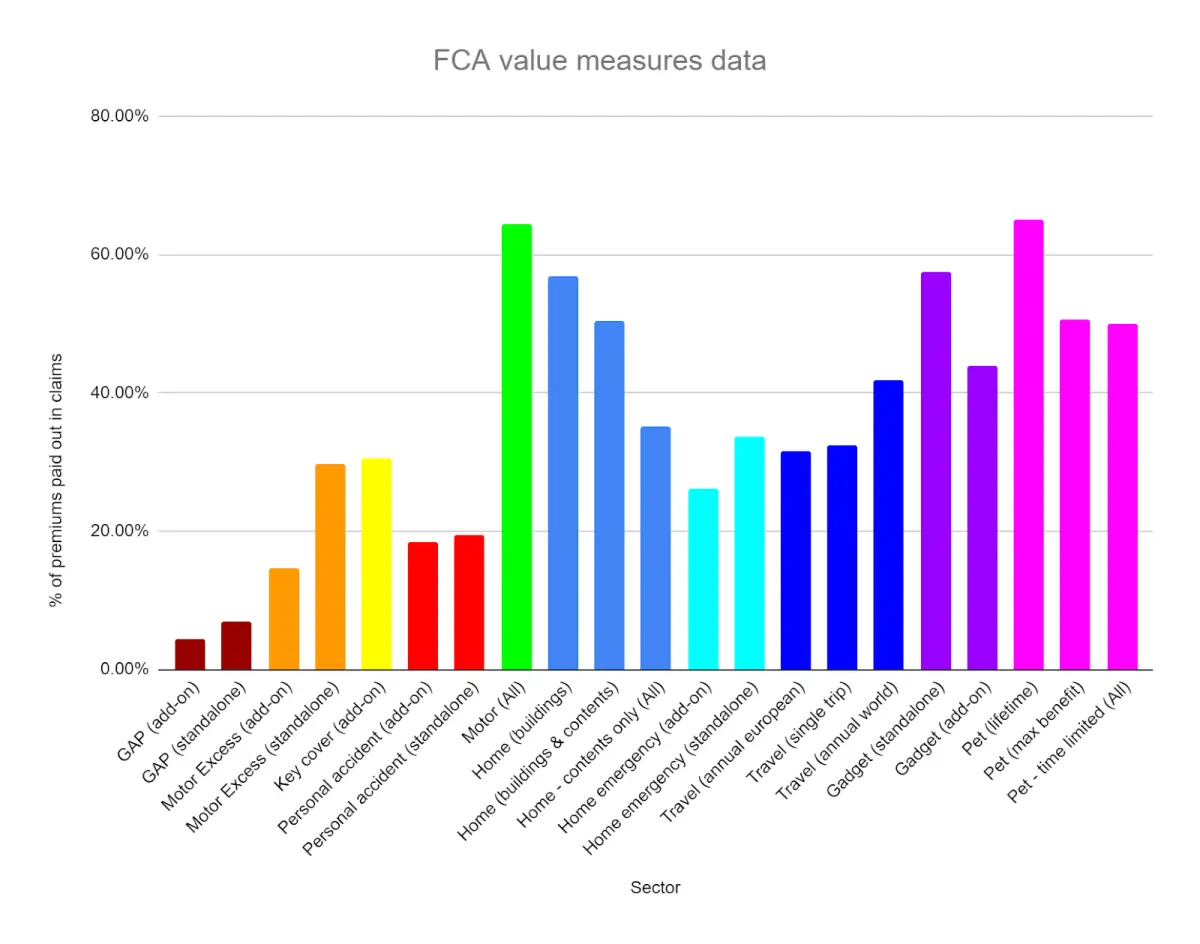
This decision was primarily driven by concerns about sales practices and the FCA’s belief that GAP insurance policies were not providing fair value to customers. This was backed up by the FCA’s general insurance value measures data (2022) which showed that GAP insurance policies paid out the lowest proportion of total premiums of any insurance sector.
As the chart below shows, most of the insurance sectors sitting at the bottom of this list alongside GAP insurance are other secondary motor insurance products. Motor excess insurance, when sold as an add-on, was the next lowest. Collectively, these policies paid out less than 15% of premiums in claims. Interestingly there was a very large difference between motor excess add-on policies and standalone ones. Standalone excess policies paid out just under 30% of premiums in claims, about double that of the add-ons.
The difference between standalone and add-on policies in motor excess insurance has some resemblance to the GAP insurance sector. In GAP insurance the FCA focussed more of its criticism on policies sold by car dealerships than those by standalone online providers. The standalone GAP policies were paying out a much higher percentage of premiums in claims than the add-ons (7% vs 4%). However, as 7% is still very low, the FCA also temporarily banned the sale of standalone policies citing fair value concerns.
Given that the FCA data shows motor excess add-ons providing the next lowest value on this measure after GAP insurance, it could soon be the sector facing more intense FCA scrutiny.
Standalone vs add-on Motor Excess Insurance
Our excess insurance dataset covers the whole of the market, with nearly 120 unique motor excess insurance policies almost evenly split between add-ons and standalone. While the average cost of a motor excess policy doesn’t vary much between those sold as an add-on and the standalones, there is a larger difference between the average level of cover (see below).
Add-on
Standalone
Mean cost
£44.95
£42.77
Median cost
£40.00
£41.00
Add-on
Standalone
Mean cover limit
£839.17
£809.82
Median cover limit
£500.00
£750.00
Motor excess insurance is a straightforward product with very limited features. The overall cover limit is the most important component and dividing that by the cost of the policy gives a good indication of a product’s financial value to customers. Using this measure, the average standalone excess policy provides £18.38 of cover per pound spent, 3.38% better value than the average add-on policy. Although this suggests the standalone policies may provide better value, the difference is much smaller than that between standalone and add-on policies in the percentage of premiums paid out in claims (30% vs 15%).
The FCA data shows that the average claim for both standalone and add-on policies is very similar at just over £400. However, excess insurance policies are available that cover far more than this. The maximum add-on policy provides £3,000 of cover while standalone policies go up to £2,000. While car insurance excesses can reach £1,000 when including voluntary excesses, and most policies allow for multiple claims, the average claim amount shows that these highest cover levels are likely to be unnecessary for the majority of customers.
When limiting the policies to only those that offer £1,000 of cover or less (enough to cover most excesses), the difference in value between add-on and standalone policies is more significant. With this limit, the average standalone policy offers £16.52 of cover per pound spent, 9.92% larger than the average add-on policy. While this difference is larger it is still a long way off explaining the difference in the FCA value measures data. Standalone policies pay out about double the percentage of total premiums in claims, the financial value of standalone policies would need to be 100% larger to completely account for the difference.
The FCA data shows that a total of £25.6m of retail premiums were written for excess cover add-ons, the standalone figure is £23.7m. However, the average number of policies in force was about six times higher for standalone policies, giving them an average cost of £12, compared to £78 for add-on policies. This suggests that the discrepancy in the percentage of premiums paid out in claims is more likely stemming from customers purchasing more cover than they need when buying add-on policies.
How are excess protection add-ons sold?
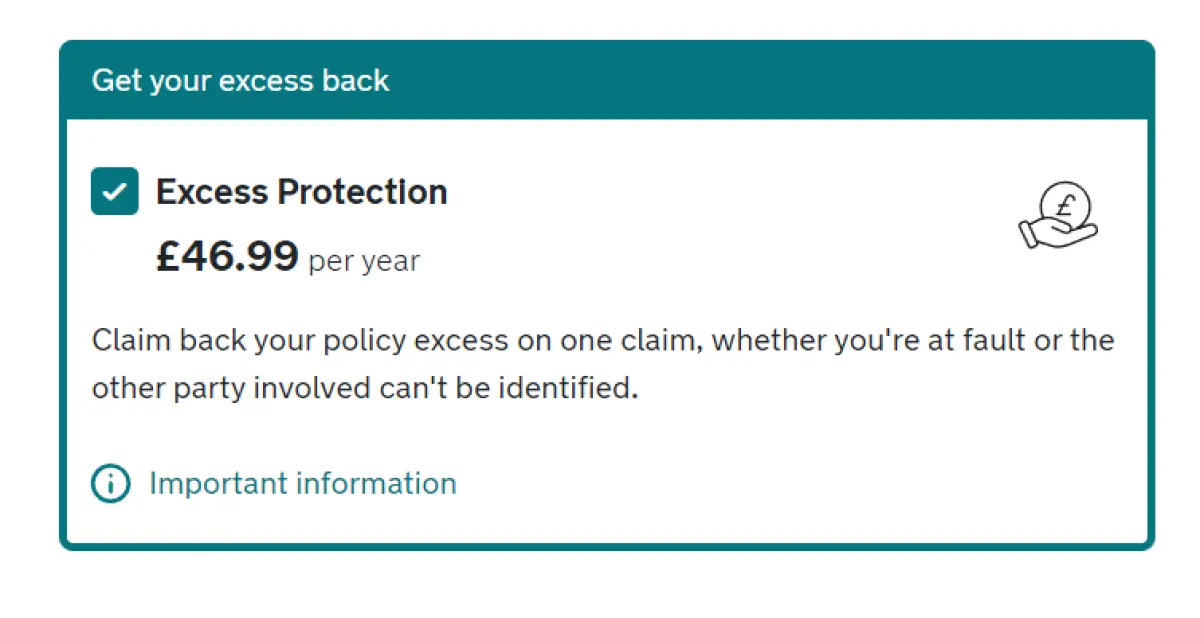
Insurers take a variety of approaches when selling excess protection add-on policies. For example, the excess protection policy sold by AA car insurance (below) adjusts depending on the size of the car insurance excess. However unlike most excess protection policies, the AA’s product only covers one claim. This means that there would be no value to larger cover levels. Providers with multiple options could still learn from this approach, for example by automatically selecting the cover level closest to the customers actual excess.
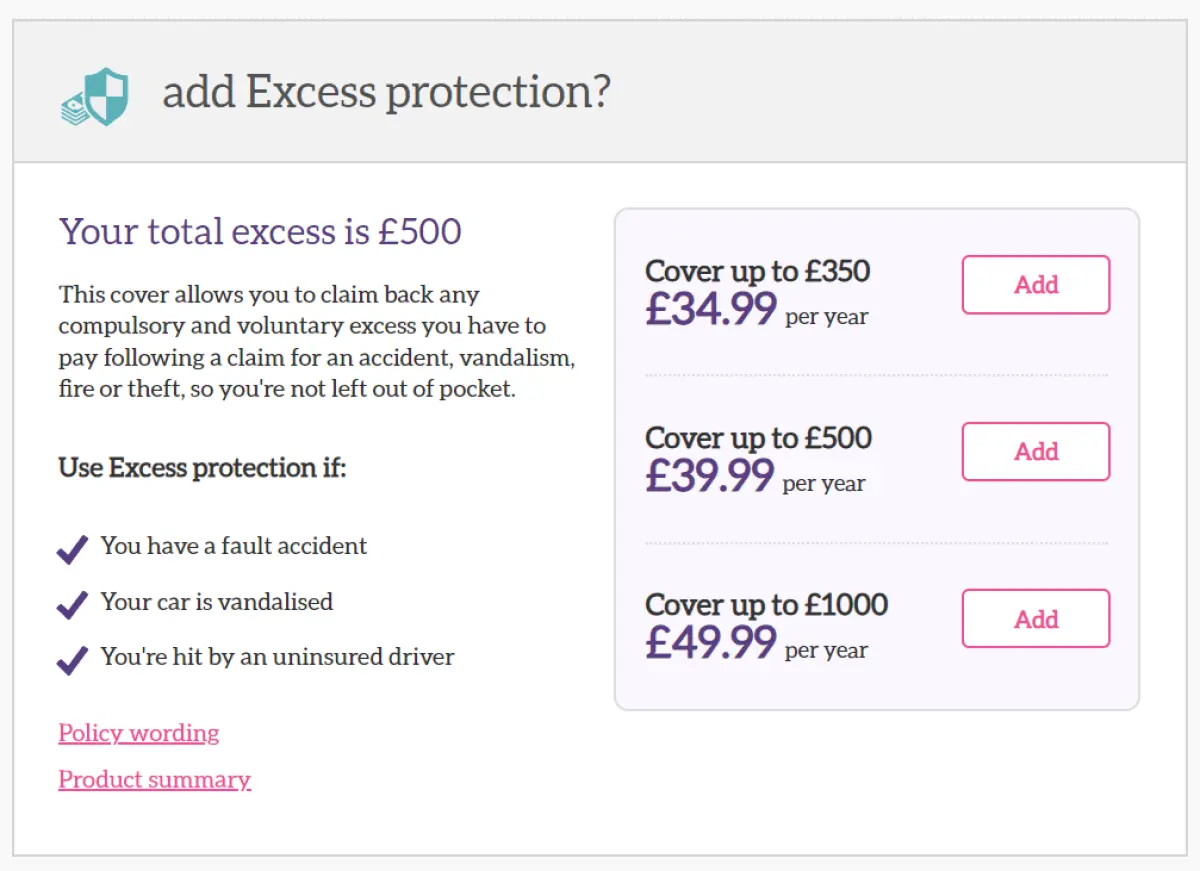
Policy Expert take a different approach (shown below), giving the customer a variety of cover level options. As the excess protection can cover more than one claim, the customer needs to select the level of cover. Helpfully they inform the customer the value of their car insurance excess, alongside the option to purchase excess protection. This gives customers valuable information to help them make a decision on the level of cover to purchase.
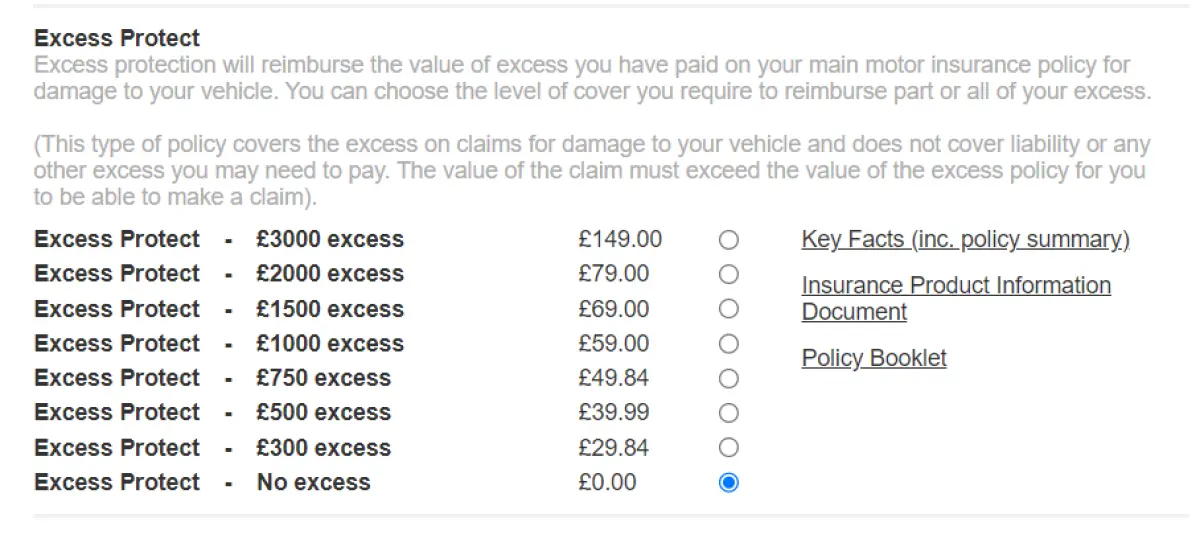
Not all providers are as helpful. Brightside Insurance, for example, sells an excess protection add-on with their car insurance and informs customers of a £1,000 cover limit. This is contradicted by the documents they provide which states that a £500 cover limit is in place. A Choice gives customers many options, with cover limits between £300 and £3,000 available. They also use gray text to explain important policy information, which makes it harder for people to read and understand. The design choices used by A Choice (below) make it much easier for a customer to select too much cover. They also don’t make it clear what the car insurance excess amount is, meaning that it is far easier for customers to purchase more cover than they need.
Choice and Understanding
Recently published data from GoCompare shows that less than half of customers properly understand excesses, with the figure much lower for younger customers. Their research found that some people don’t understand that you have to pay both the voluntary and compulsory excess, and that many didn’t realise how much their excess was. This obviously has big implications for firms selling excess protection policies, if customers don’t understand excesses they are unlikely to understand excess insurance.
Overwhelming customers with choice without properly informing them makes it more likely that they will buy an unsuitable product, potentially paying more for cover they don’t need. Firms should follow the lead of Policy Expert and show the customers how much their excess is when they are offered the excess add-on. Or alternatively follow AA’s example and only provide cover that automatically adjusts to the value of the excess.
None of the excess add-on providers make it clear that there are other options available to purchase excess protection. The anchoring and endowment effects mean customers are less likely to shop around, giving add-on providers a competitive advantage. This could explain why our data shows add-on providers charge more than standalone providers for equivalent cover. Shopping around leads to better customer outcomes and firms should do more to inform customers about alternatives, particularly if none of their policies are suitable. A customer with a £300 excess is very unlikely to get any extra benefit from £3,000 of excess protection when compared to a £750 or £1,000 policy.
Conclusion
Fairer Finance data shows that excess protection policies sold by standalone providers are likely providing better financial value than those sold as add-ons. However the main harm in the excess protection market appears to be customers purchasing unsuitable policies with more cover than necessary. While the convenience of an add-on policy does provide some extra value to consumers, add-on providers should explain to customers that excess protection policies are available to purchase from other providers.
Providers need to do more to inform customers about excesses, and ensure that they display the customer’s excess alongside the information about excess protection add-ons. In addition, firms should display statistics about historical claims using graphs, making it easier for customers to understand how they are protected. An example of this is the Tesco Bank pet insurance journey, where they show customers the percentage of claims they receive that would have been covered with the selected cover level.