By Peter Roper

Every six months, Fairer Finance polls 10,000 banking customers and asks them:

‘Based on everything you know about this provider, to what extent would you agree or disagree with the following statement - “I trust [name of their provider]” ’

We use the responses from this question to create a trust score, which allows us to track perceptions of trust in banking providers.

To create our trust score we subtract the proportion of negative responses from positive ones, and double-weight the extreme responses to factor in strong opinions. This helps to simplify the responses and gives us a score out of 100%.

Trust scores rose slightly across all five banking sectors in Autumn 2026, continuing the long term trend of rising trust in banking sectors since we started the survey in Spring 2015. Current accounts and credit cards saw the biggest improvements of around 1.4p.p for both, while mortgages rose the least at 0.4p.p. Savings accounts remain the most trusted sector with an average trust score of 66.02%, and mortgages remain the least trusted at 58.47%. This wave we also started asking some new questions, including how credit card customers repay their card each month.

Current Accounts

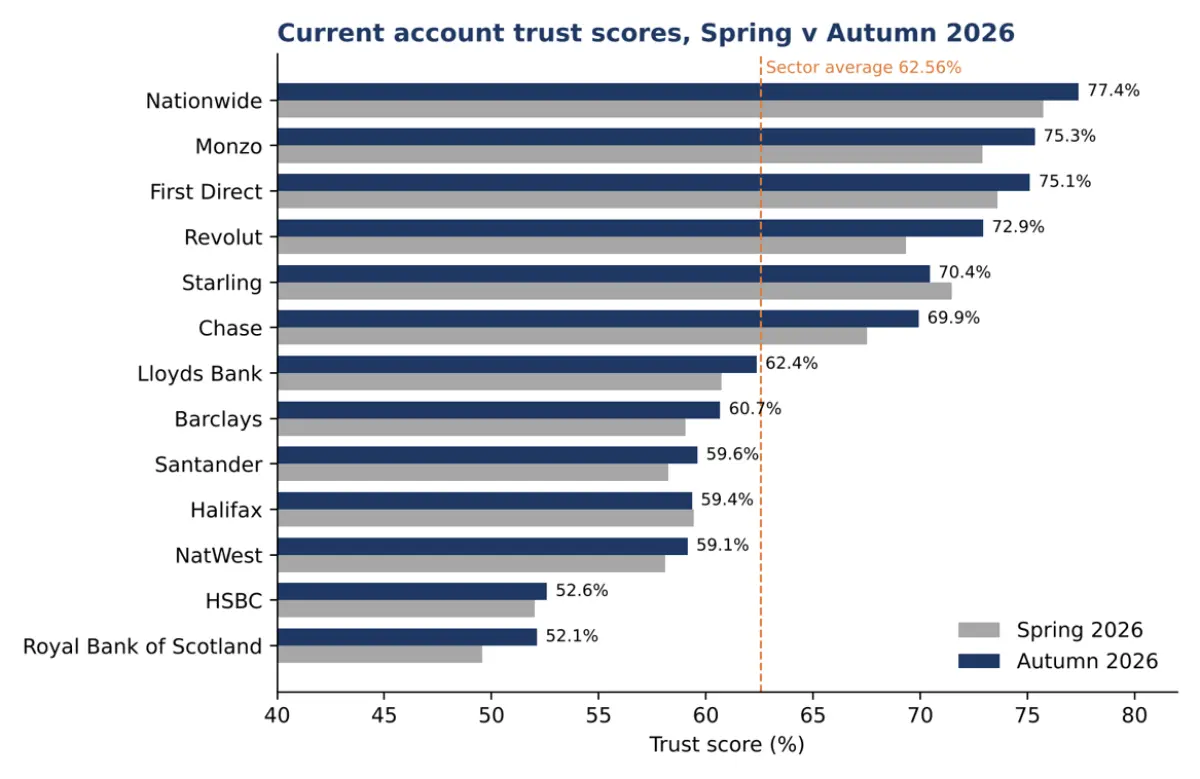
Nationwide has the highest trust score for current accounts again in Autumn 2026 improving by 1.67p.p to a score of 77.39%. Nationwide now sits almost 15p.p above the market average and came first overall in the Fairer Finance Customer Experience Ratings, the first time a major high street provider has done so. Monzo is in second place after improving by 2.43p.p to 75.34%. First Direct came third on 75.12%. Most providers (18 of 22) improved their scores since the Spring index.

The digital banks had a mixed wave. Revolut saw the biggest improvement of any current account provider, rising 3.61p.p to 72.94%, and Chase also improved by 2.41p.p to 69.93%. Starling on the other hand dropped for the second wave in a row. Starling’s trust score fell by just over 1p.p to 70.44%, meaning it now sits below Revolut. Starling used to score over 80% back in 2022 but has seen a declining score as it became a more established brand. Despite this trend Starling remains one of the highest performing brands and ranks 6th on our trust index for current accounts.

At the other end of the table HSBC and Royal Bank of Scotland continue to have the lowest trust scores at 52.59% and 52.12%. RBS did see one of the bigger improvements this wave (up 2.55p.) while HSBC improved by 0.59p.p. The graph below shows the trust scores of the main current account providers in Spring and Autumn 2026.

Trust Amongst Financially Struggling Customers

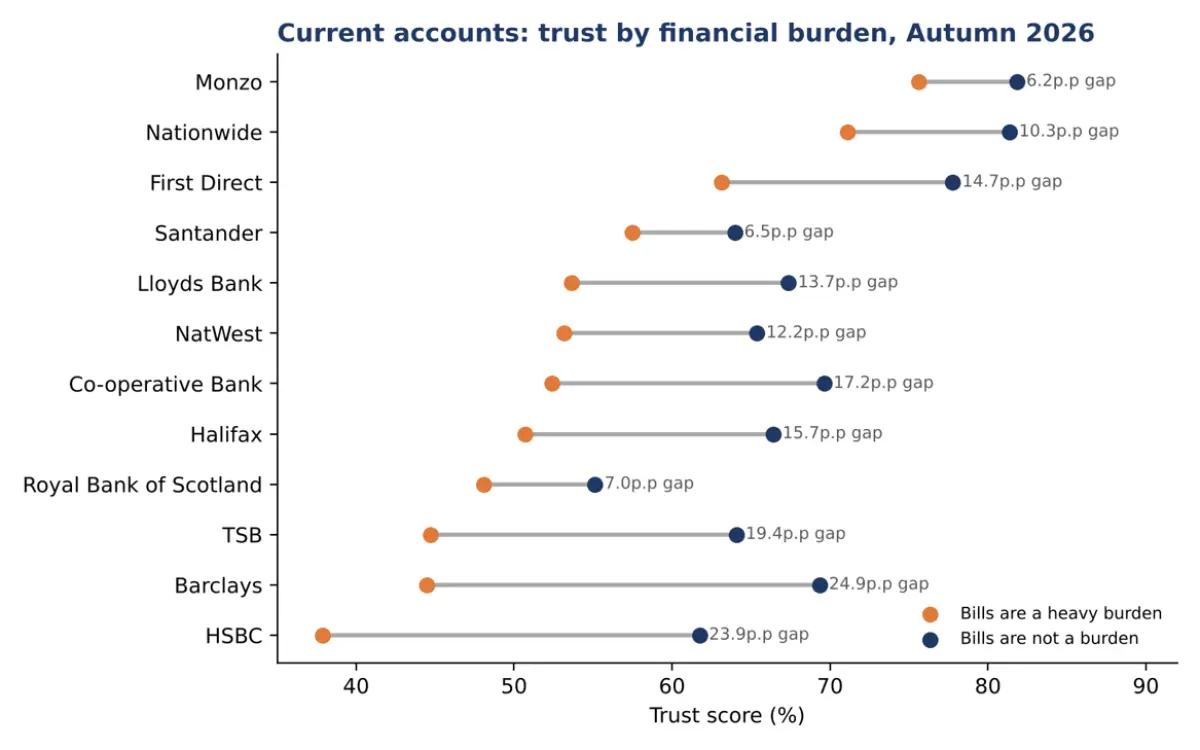
We ask participants about financial vulnerability by checking if bills are a heavy burden for them. Across all of the banking sectors financial strain makes a much bigger difference to trust than income does. In current accounts customers who find their bills a heavy burden have an average trust score of 53.71% compared with 68.53% for those who don’t find bills a burden at all. In comparison the gap between customers with an income below £20,000 and those earning over £70,000 is only 3.35p.p.

Monzo stands out with the highest trust score amongst struggling customers at 75.64%. This is only 6.19p.p below its score from customers who don’t find bills a burden at all. Nationwide is second amongst this group on 71.10%. This contrasts with some of the other large banks, Barclays and HSBC both have gaps of around 24p.p. HSBC’s score of 37.85% amongst customers struggling with bills is the lowest of any of the larger current account providers. The graph below shows the trust scores of both customer groups for the larger banks.

Credit Cards

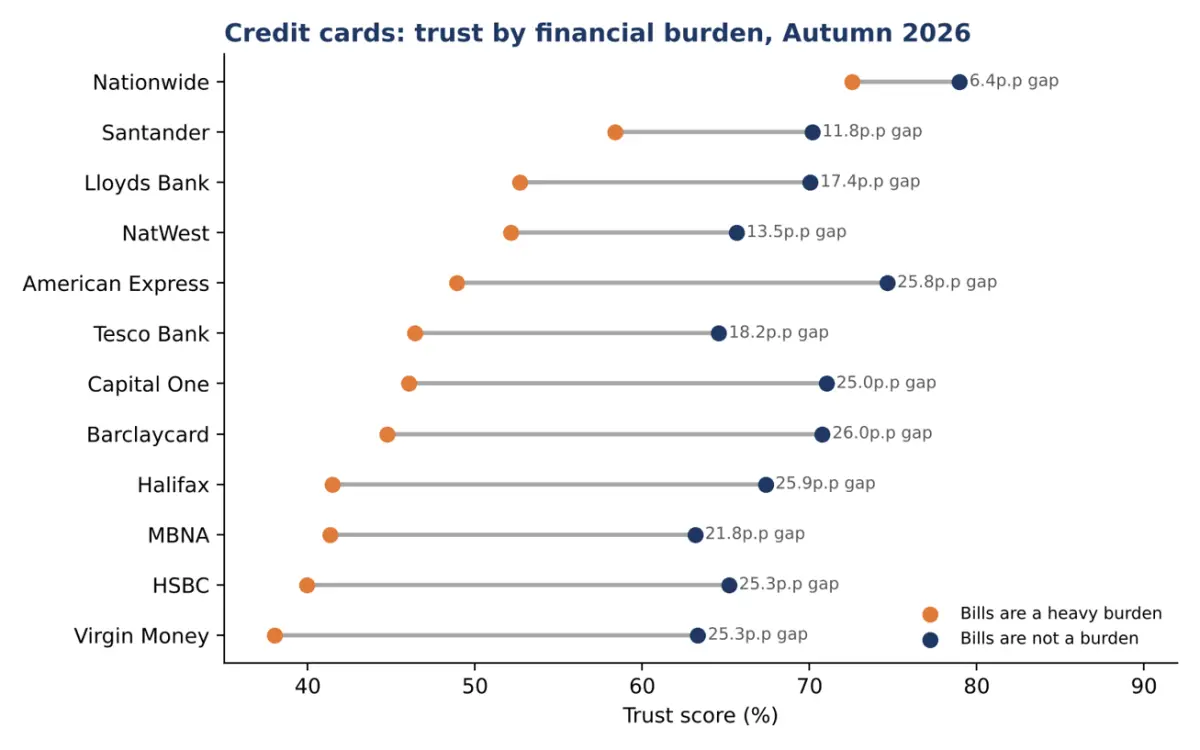
In our Spring update we highlighted the large gaps in trust between financially struggling customers and other customers at Capital One and American Express. It is good to see that both gaps have narrowed this wave. Capital One’s gap has fallen from 33.10p.p to 24.98p.p, driven by a big improvement in trust amongst its customers who find bills a heavy burden (36.26% to 46.02%). The gap for American Express has narrowed from 28.67p.p to 25.75p.p.

Nationwide continues to have by far the smallest gap of the large providers at just 6.41p.p, with customers who find bills a heavy burden still giving it a trust score of 72.55%. That is higher than the score most other credit card brands get from customers who have no problem paying their bills. The graph below shows the gap for each of the major credit card providers in Spring and Autumn 2026.

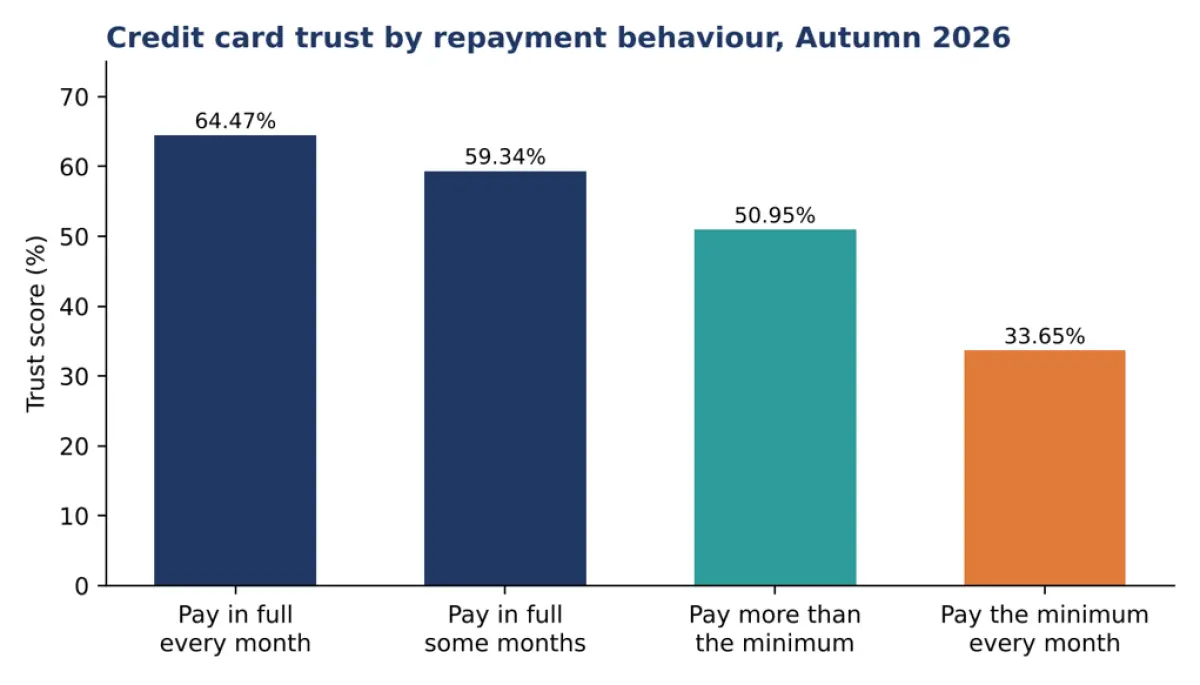
We have started asking credit card customers how they repay their card. Customers who pay their balance off in full every month have an average trust score of 64.47%, but this falls to 50.95% for customers who pay more than the minimum but never clear their balance. Those who only make the minimum payment every month have a trust score of just 33.65. That is a difference of more than 30p.p between customers who clear their balance and those paying only the minimum. This supports the point we made in Spring that customers who are paying interest are far less happy with their providers than those who use their card without paying interest and collect the rewards. The graph below shows trust scores by repayment behaviour.

Personal Loans

118 118 Money saw the biggest drop of any banking brand this wave, falling 8.20p.p to 22.44%, which is the lowest trust score in any of the banking sectors. Zopa and Bank of Scotland also saw big drops of just over 6p.p. Zopa also fell by 5.24p.p in credit cards. Monzo saw the biggest improvement, rising 5.45p.p to 75.27%, followed by Admiral who improved by 4.91p.p to 54.87%.

Mortgages

Mortgages remain the least trusted of the banking sectors with an average trust score of 58.47%, and saw the smallest increase since Spring. Nationwide is again the most trusted of the big lenders at 67.33%, followed by Lloyds Bank on 65.16%. Santander saw the largest drop amongst the big lenders, falling by 1.72p.p to 54.07%, and is now the least trusted of this group.

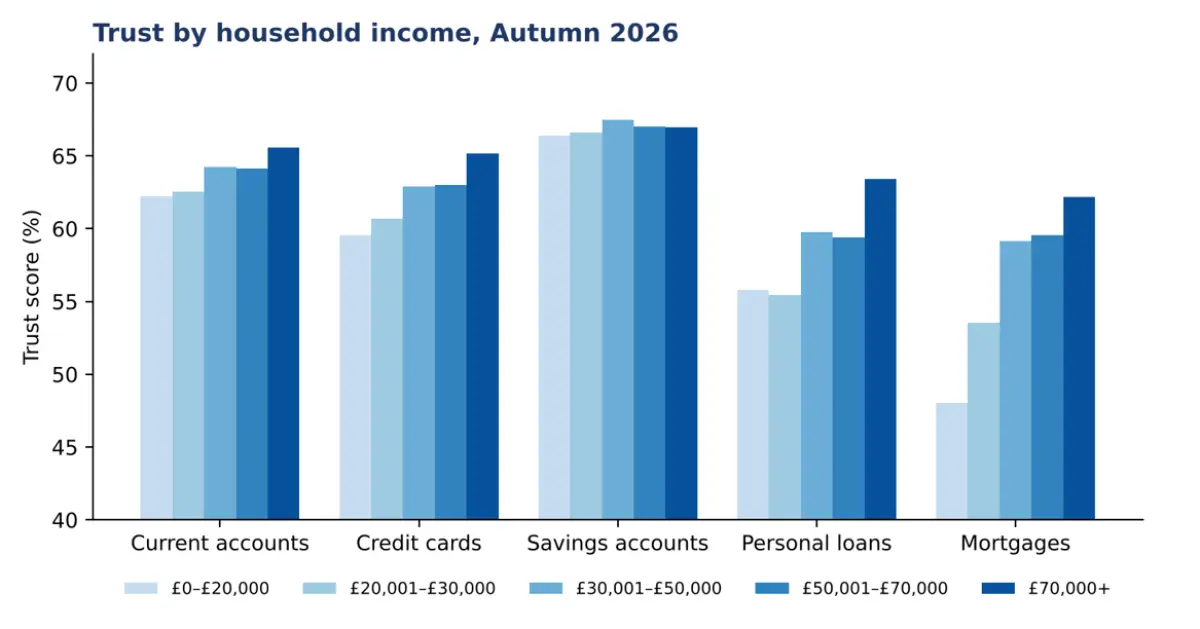
Income makes a much bigger difference to trust in mortgages than in any other banking sector. Mortgage customers with an income of £20,000 or less have an average trust score of 48.01%, compared with 62.20% for those earning more than £70,000, a gap of over 14p.p. In the other banking sectors this gap ranges from less than 1p.p for savings to 7.6p.p for personal loans. The graph below shows trust by household income across all five sectors.

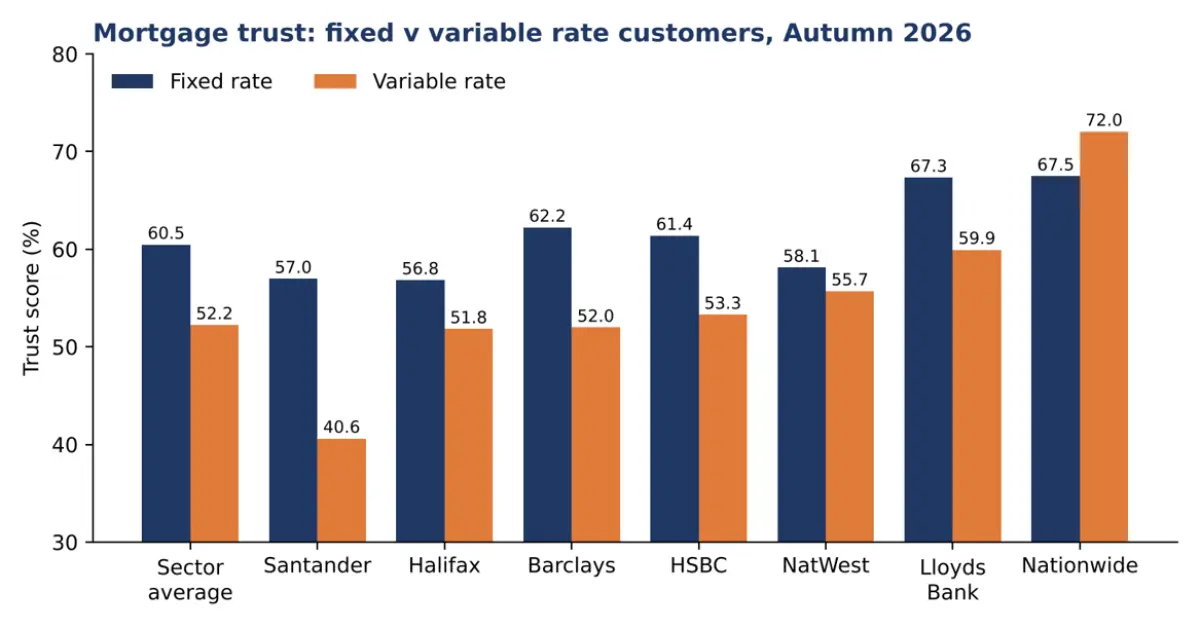
There is also a clear difference between fixed and variable rate customers. Fixed rate customers have an average trust score of 60.46% compared with 52.23% for those on a variable rate. This may reflect the fact that variable rate customers are more exposed to changes in their monthly payments, and some will have moved onto their lender’s standard variable rate at the end of a fixed deal. Santander has the biggest gap, with its variable rate customers giving a trust score of just 40.60% compared to 56.96% for fixed. Nationwide is the only big lender where variable rate customers trust it more than fixed rate customers, at 72.04% compared to 67.47%. The graph below shows trust scores for fixed and variable rate customers at the big lenders. This could stem from issues with how providers are communicating with customers as they come towards the end of their fixed rate period.