· Investments & travel insurance Ts&Cs rival literary classics in word count, reveals Fairer Finance
· Car insurance and investments Ts&Cs have the highest reading age at 17.5 years, while one in seven adults in England has the literacy skills expected of a 9 -11 year old
· Minimal improvement in jargon scores of financial services firms
As we pass the one-year mark since the introduction of the FCA’s Consumer Duty, Fairer Finance has found that the complexity of financial documents has barely improved over the last 12 months.
Consumer Duty states that firms should communicate with customers not only in a way that is ‘clear, fair and not misleading’ but also to equip them with the information needed to make effective and informed decisions.
However, Fairer Finance's analysis of the readability of financial terms and conditions and policy documents reveals that reading ages, use of jargon, and word length have barely improved across key financial products in the past year.
7.1 million people are deemed “functionally illiterate”, yet reading ages for financial products range from 15 to 18 years old
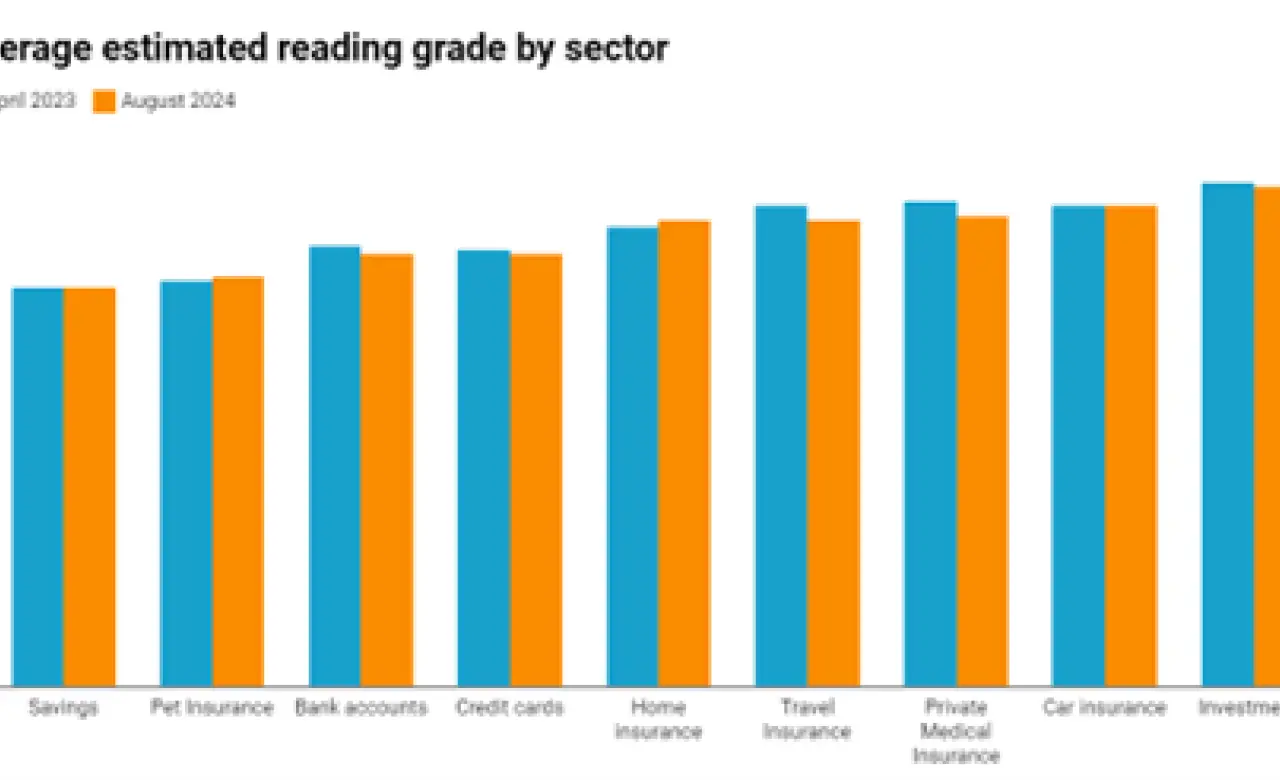
Fairer Finance discovered that investment and car insurance terms and conditions require the highest reading age, averaging 17.5 years. Savings accounts and pet insurance have the lowest average reading age at 15.5 years. However, there is much inconsistency within sectors; for example, credit card providers' reading age ranges from 11 years to over 20 years. Despite the onset of Consumer Duty, average reading ages have changed little in the last 12 months which suggests most firms haven’t yet substantially re-written their terms/policy wordings.
The National Literacy Trust reports that 16.4% of adults in England (7.1 million people) have “very poor literacy skills” classifying them as “functionally illiterate” as reading information from unfamiliar sources or on unfamiliar topics could cause them problems. These consumers with poor literacy skills are also deemed “vulnerable” by the FCA. Furthermore, the government estimates that one in seven adults in England (14.9%) has the literacy skills expected of a 9 – 11 year old.
Note in the graph above, reading grades are calculated by looking at the average word and sentence length of a document. To convert from reading grade to reading age, add 4.5. These reading grades are calculated using the Automated Readability Index.
Jargon Scores show minimal improvement
Fairer Finance has developed a jargon score to analyse the legal, industry, and everyday jargon in financial documents. As with reading ages, jargon scores have had minimal movement in the last year, although pet insurance, bank accounts, and savings terms do seem to be moving in the right direction. Investment terms and conditions remain the most difficult to understand.
Travel insurance Ts&Cs rival literary classics in word count
Fairer Finance has also identified the products with the highest word counts in their terms and conditions. Travel insurance policies and investments top the list, closely followed by home insurance policies.
Travel insurance and investments’ terms and conditions average around 24,000 words - equivalent to literary classics such as Shakespeare’s Romeo & Juliet and Oscar Wilde’s The Importance of Being Earnest2.
Some products’ terms, such as Barclays Smart Investor, contain more than double the average, at almost 49,000 words. This is greater than the word counts of The Great Gatsby (c47,000 words) and Animal Farm (c30,000 words).
While average bank account Ts&Cs can tally almost 17,000 words, Danske Bank’s Personal Banking Terms and Conditions contains over four times as many, with over 74,000 words, almost on a par with Harry Potter & The Philosopher’s Stone (77,325).
James Daley, Managing Director at Fairer Finance, the consumer group and ratings provider, commented: “It’s disappointing that more than a year after the Consumer Duty came into force, we’ve barely seen any improvement in the clarity of financial terms and conditions. The new FCA rules are very clear that firms must be able to prove that their customers can understand the information they are given. However, the reading ages, length and complexity of most Ts&Cs are well above the level that most people will find easy to engage with.
“We know that some firms are busy addressing these issues. But others are taking the view that no one reads the Ts&Cs so there’s no need to act. We expect that these firms will be having some tough conversations with the regulator over the months ahead.
“We know from experience that it’s absolutely possible to create Ts&Cs that are clear and simple for customers to understand – whilst still meeting the requirements of legal and compliance teams. Ts&Cs are used by customers as manuals – which is why it’s crucial they are well organised and make it easy for people to find the information they are looking for. When they get there, they shouldn’t need a legal degree to be able to understand it.”
For more detail on Fairer Finance’s analysis of terms and conditions and policy wording please visit www.fairerfinance.com.
Notes to editors
For further information, please contact:
Karen Mignon, KM Comms: karen@kmcomms.co.uk / +44 7766 651327
Louise Ahuja, KM Comms: louise@louisebcomms.co.uk/ +44 7788 676913
1 - https://literacytrust.org.uk/parents-and-families/adult-literacy/what-do-adult-literacy-levels-mean/
2 - https://www.opensourceshakespeare.org/views/plays/plays_numwords.php and https://www.anycount.com/word-count-of-books/word-count-of-top-100-books/ and https://commonplacebook.com/art/books/word-count-for-famous-novels/
About Fairer Finance
Fairer Finance is an independent consumer group and ratings provider whose mission is to help create a financial services market which is fair for consumers as well as the companies that serve them. With a heritage spanning almost a decade, Fairer Finance’s unique and impartial Product Ratings are simply designed to help consumers make sense of the complex world of financial products. It rates over 6,000 products spanning over 20 sectors, ranging from bank accounts, credit cards, car insurance and travel insurance.
Its Customer Experience Ratings are designed to help consumers make more informed decisions based on quality and service and not just price (eg trust, complaint-handling, transparency etc).