9th October 2026
SSISAs and cash interest
Consumers face equity ISA “cash trap” as tax changes loom and investment platforms pay punitively low interest rates
Consumers are being urged to check what interest they're earning on cash held in self-select stocks and shares ISAs, before a wave of rule changes leaves them worse off - or trapped.
From next year, a new 22% tax will apply to interest earned on cash held in stocks and shares ISAs, while savers will also be barred from transferring money out of a stocks and shares ISA into a cash ISA. Consumer group Fairer Finance warns this could leave investors stuck holding low or no-interest cash with nowhere better to put it.
The consumer group's analysis of providers in its self-invested stocks and shares ISA ratings found that 21 of 46 providers - 46% - currently pay no interest at all on uninvested cash. That list includes HSBC and the Bank of Scotland group (Halifax, Lloyds, BofS and Scottish Widows), all of which pay interest only on their SIPP products, not their ISAs.
Rates falling faster than the base rate
Since August 2024, the Bank of England base rate has fallen by 1.50 percentage points - a 29% drop. But many self-invested stocks and shares ISAs have cut their rates even harder and faster.
Of the 46 providers that Fairer Finance rates, 33 offer rates of less than 2% and 37 out of 46 offer less than 3%.
Interactive Investor: rates on higher cash balances (over £100,000) have fallen from a high of 4.75% in August 2024 to just 2.10% today - a 56% cut.
Hargreaves Lansdown: rates on balances below £10,000 have dropped by more than half, from 3% to 1.30%.
Aviva: has more than halved its rate since July 2024 - though it has also restructured its charges, scrapping its 0.40% cash holding fee in favour of retaining a slice of the interest earned instead.
Figure one (below) shows how interest rates on £5,000 of uninvested cash have moved across some of the UK's largest investment platforms over the past three years.
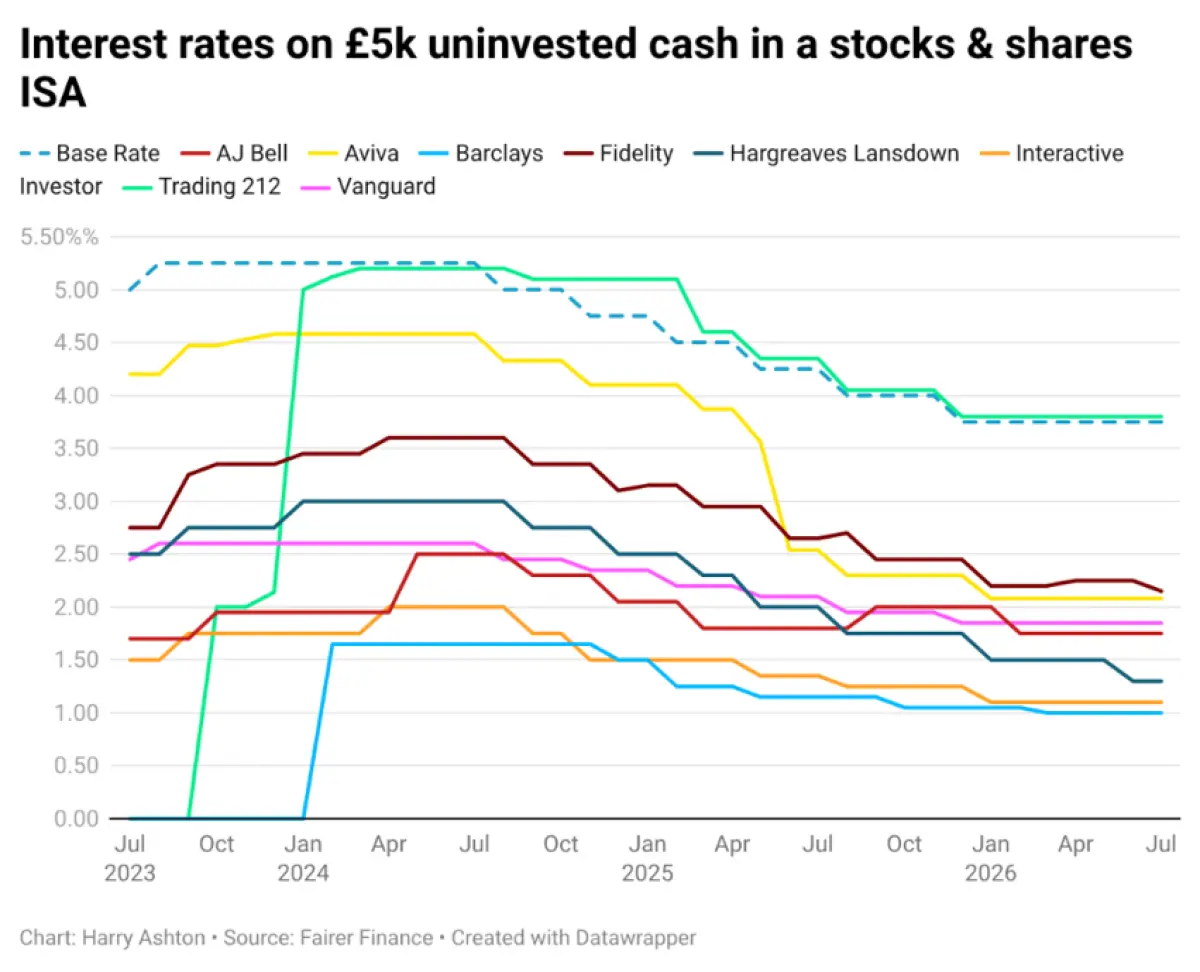
Freetrade caps its rates at a maximum of £1,000, £2,000 and £3,000 on its Basic, Standard and Plus accounts respectively. The rates are 1%, 2.5% and 3.5%.
Hargreaves’ highest offered rate is 2.15% on its stocks and shares ISA, which only applies to large balances of £1m+. The rate up to £20,000 is just 1.3%, then 1.65% up to £100,000.
Interactive Investor offers 1.1% up to £20,000, with a top rate of 2.1% over £100,000.
James Daley, managing director at consumer group Fairer Finance, said: “It’s quite normal for investors to hold cash in their investment accounts. Income that’s not automatically reinvested or maturing investments, can legitimately build up cash on account, and many investors may take their time to decide where to allocate it. Some investors may actively choose to increase their cash balances at certain parts of the market cycle. Penalising investors by not paying proper interest on cash holdings risks discouraging responsible investing rather than encouraging it.
“Consumers now face a triple blow: a new tax on cash held in their stocks and shares ISA, no ability to transfer back to a cash ISA, and investment platforms paying little or no interest. It’s now approaching three years since the FCA wrote to investment platforms raising concerns about how they treat interest earned on customers’ cash. Some brands responded by raising their rates - but many have stayed low, and a significant number have never paid interest at all.
"With the base rate falling over the past two years, the question remains: are investment platforms still delivering fair value to their customers?"
The FCA’s warning
The FCA1 surveyed 42 investment platforms and SIPP operators in 2023 and in June 2023 alone, found those firms collectively earned £74.3m in revenue from retaining interest on client cash balances.
Sheldon Mills, the FCA's Executive Director of Consumers and Competition at that time, wrote to platforms: rising rates meant greater returns on cash, and providers needed to show that what they retained - and, for those "double dipping," what they charged customers holding cash - added up to fair value. Those that couldn't make that case, he said, needed to change. Those that didn't, would face intervention.
Fairer Finance argues that obligation hasn't disappeared just because rates have fallen. Providers must still be able to prove they're delivering fair value - and must not cut rates more aggressively than the market justifies.
For more information on Fairer Finance please visit www.fairerfinance.com.
- ENDS -
Notes to editors
For further information, please contact:
Karen Mignon, KM Comms: karen@kmcomms.co.uk / +44 7766 651327
Louise Ahuja, KM Comms: louise@louisebcomms.co.uk/ +44 7788 676913
1 - Dear CEO Letter: The retention of interest earned on customers’ cash balances
About Fairer Finance
Fairer Finance is an independent consumer group, consultancy and ratings provider whose mission is to help create a financial services market that is fair for consumers as well as the companies that serve them. With a heritage spanning over a decade, it regularly engages with regulators, government, and industry bodies helping to influence and shape new pieces of legislation and regulation. Its independent economic impact studies inform evidence-based policy.
Fairer Finance’s unique and impartial Product Ratings are simply designed to help consumers make sense of the complex world of financial products. It rates over 6,000 products spanning over 20 sectors, ranging from bank accounts, credit cards, car insurance and travel insurance. The Customer Experience Ratings are designed to help consumers make more informed decisions based on quality and service and not just price (e.g. trust, complaint-handling, transparency etc).